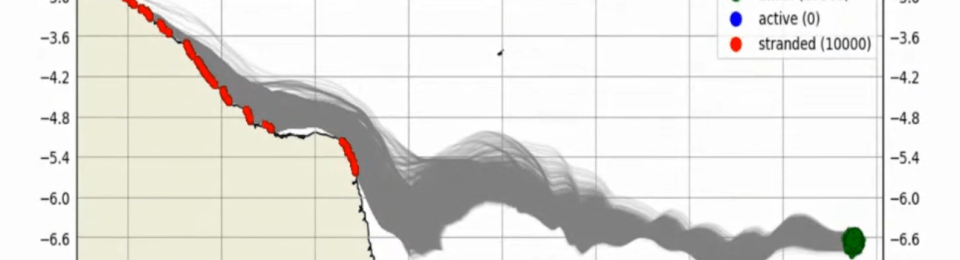
In 2019, I wrote about my investigations into the mystery bales that washed up on the beaches along the North East coast of Brazil. Since then, I have been in touch with Professor Luis Ernesto from the Institute of Marine Sciences (LABOMAR) at the Federal University of Ceará. This post is about his team’s findings.
After speaking to Luis and, perhaps due to spending even more time at home during these Covid days, my normal love of an investigation went into overdrive, as I was led from the 2nd World War and the little known part that Brazil played in it, to the potentially lethal and growing problem lurking in the world’s oceans as a result of war.
I ended up with a rather long piece, so I have decided to break it down into a series of posts. Here is Part 1: a recap of my original post and Part 2: the information into the bales origin as researched by LABOMAR.
Part 1:
My original blog post is here, read on for a brief recap or, click here to jump to Part 2;
The bales began washing up on beaches in late February 2019. Most were unmarked but I found a single bale stamped with “PRYE ESTATE” stamped into it. An internet search revealed that this was a coconut and rubber plantation in Penang, Malaysia, which began before the 1870s and ended sometime before 1967 when the land was sold off.
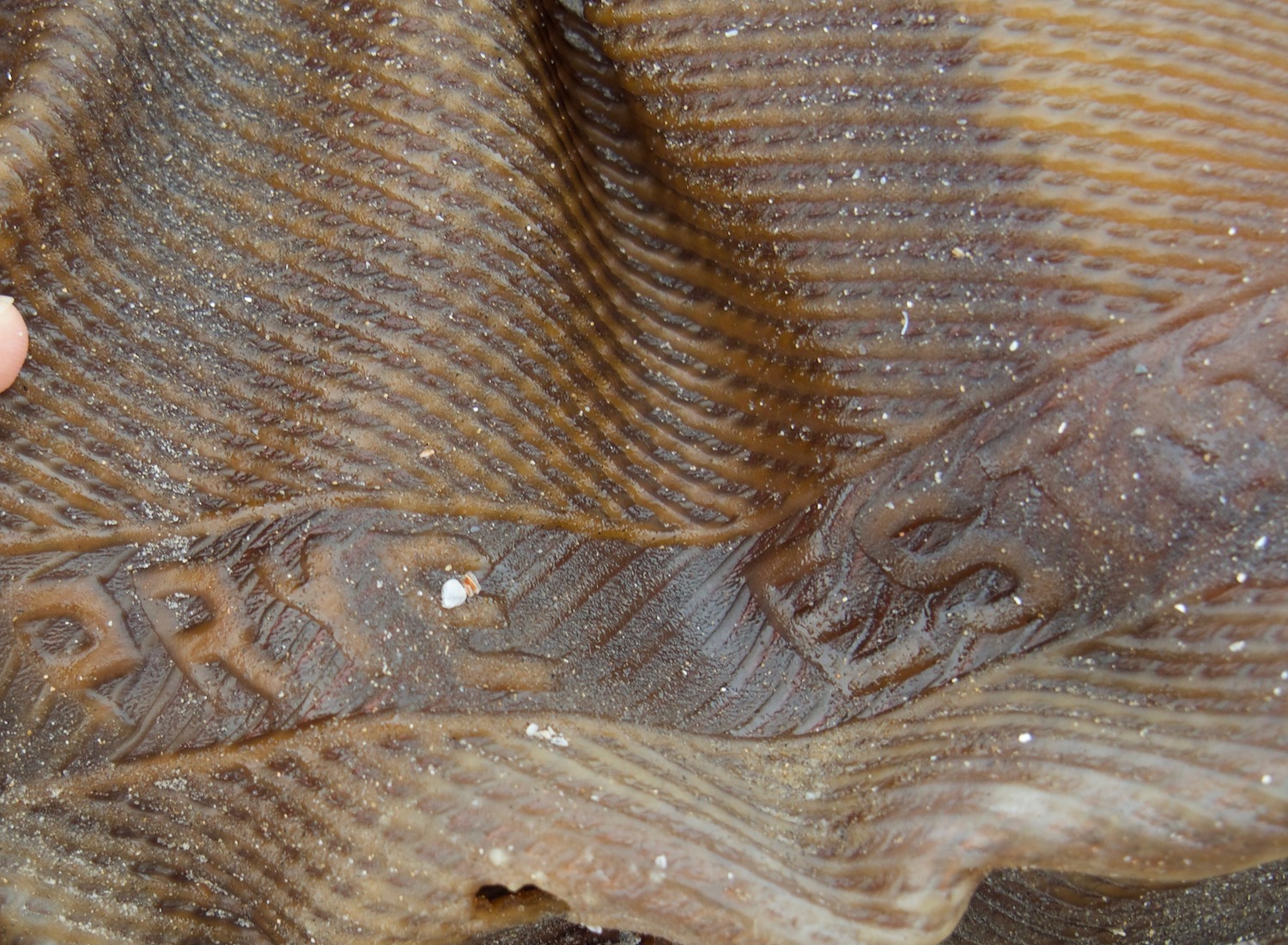
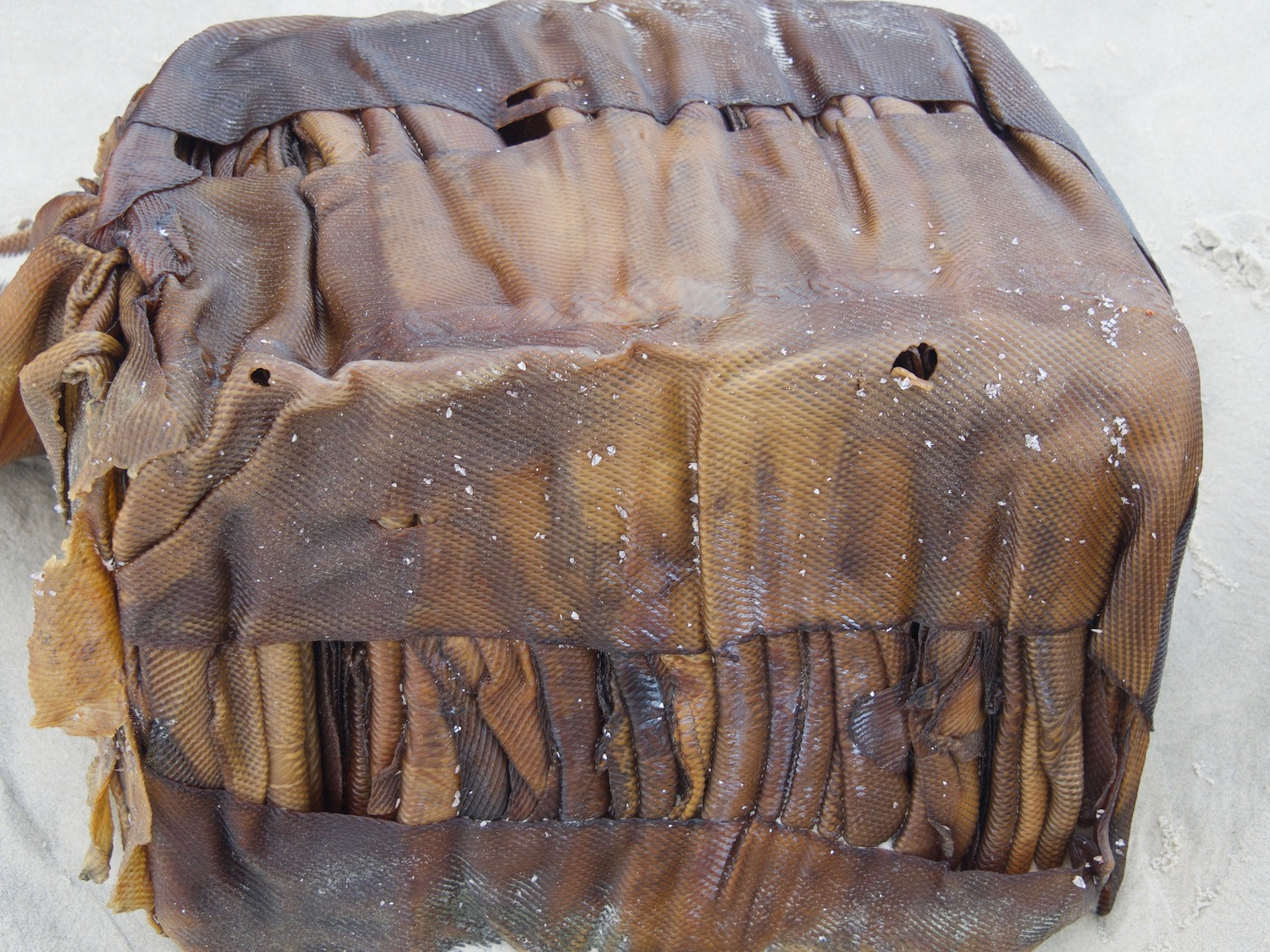
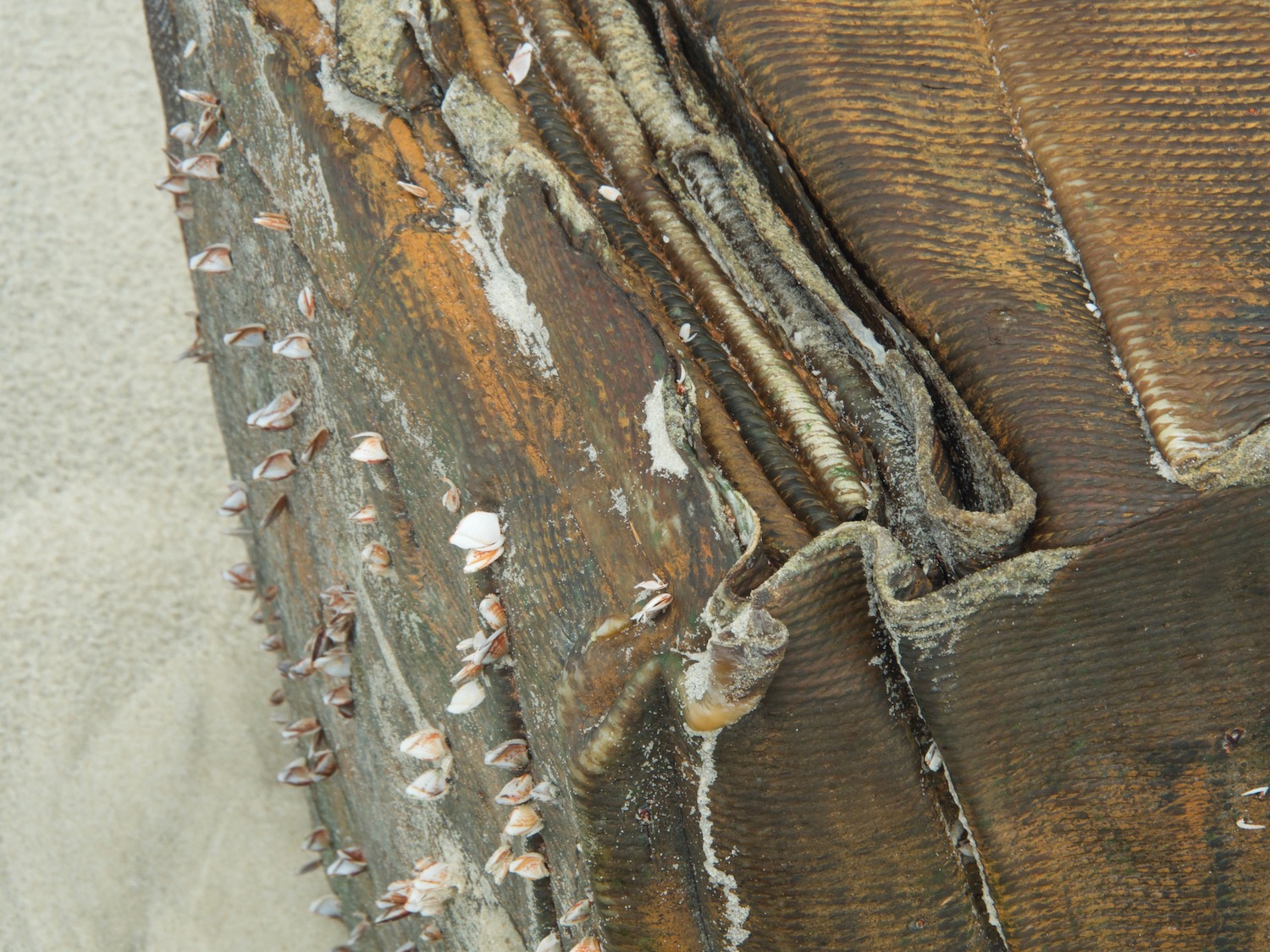
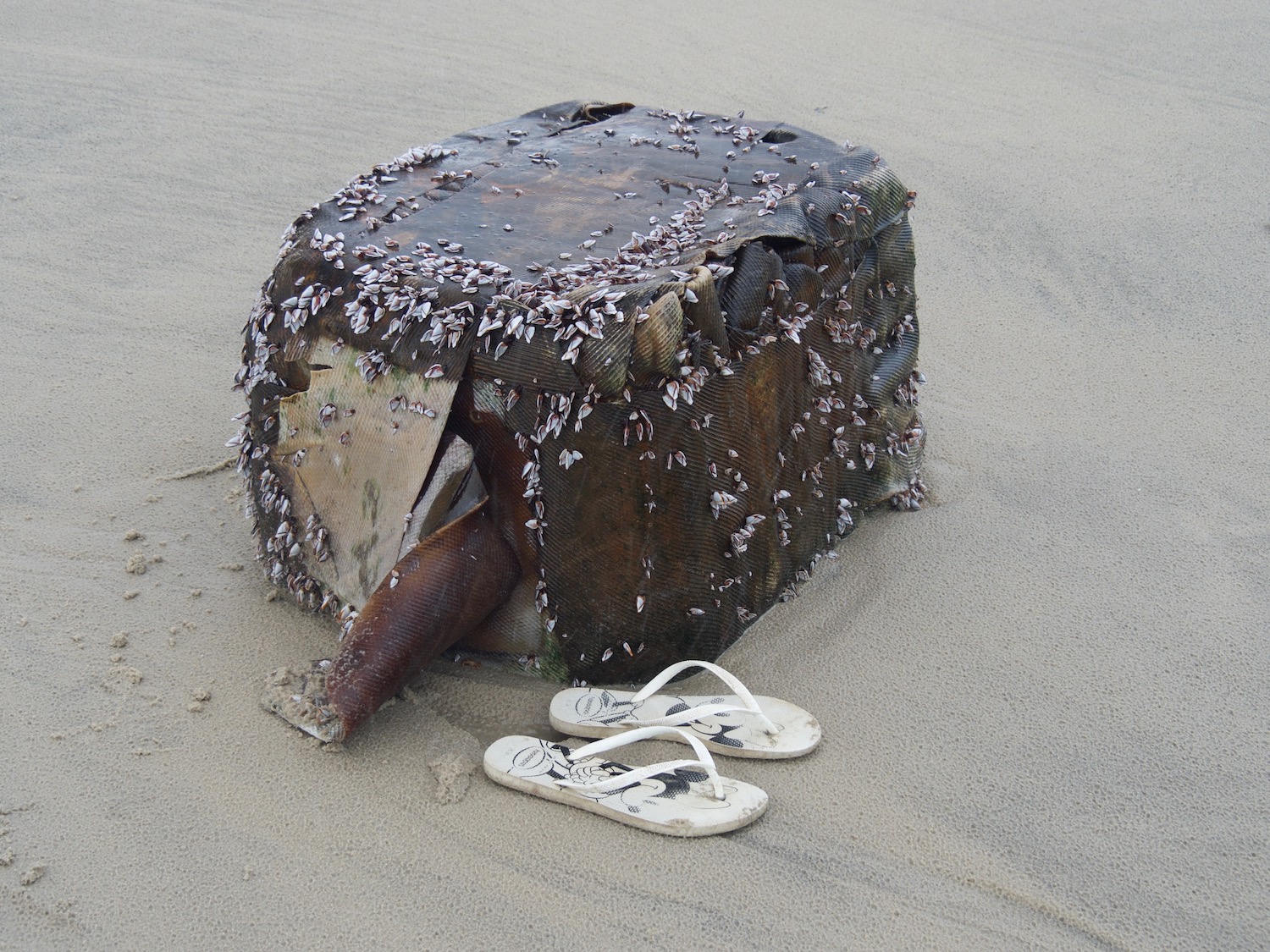
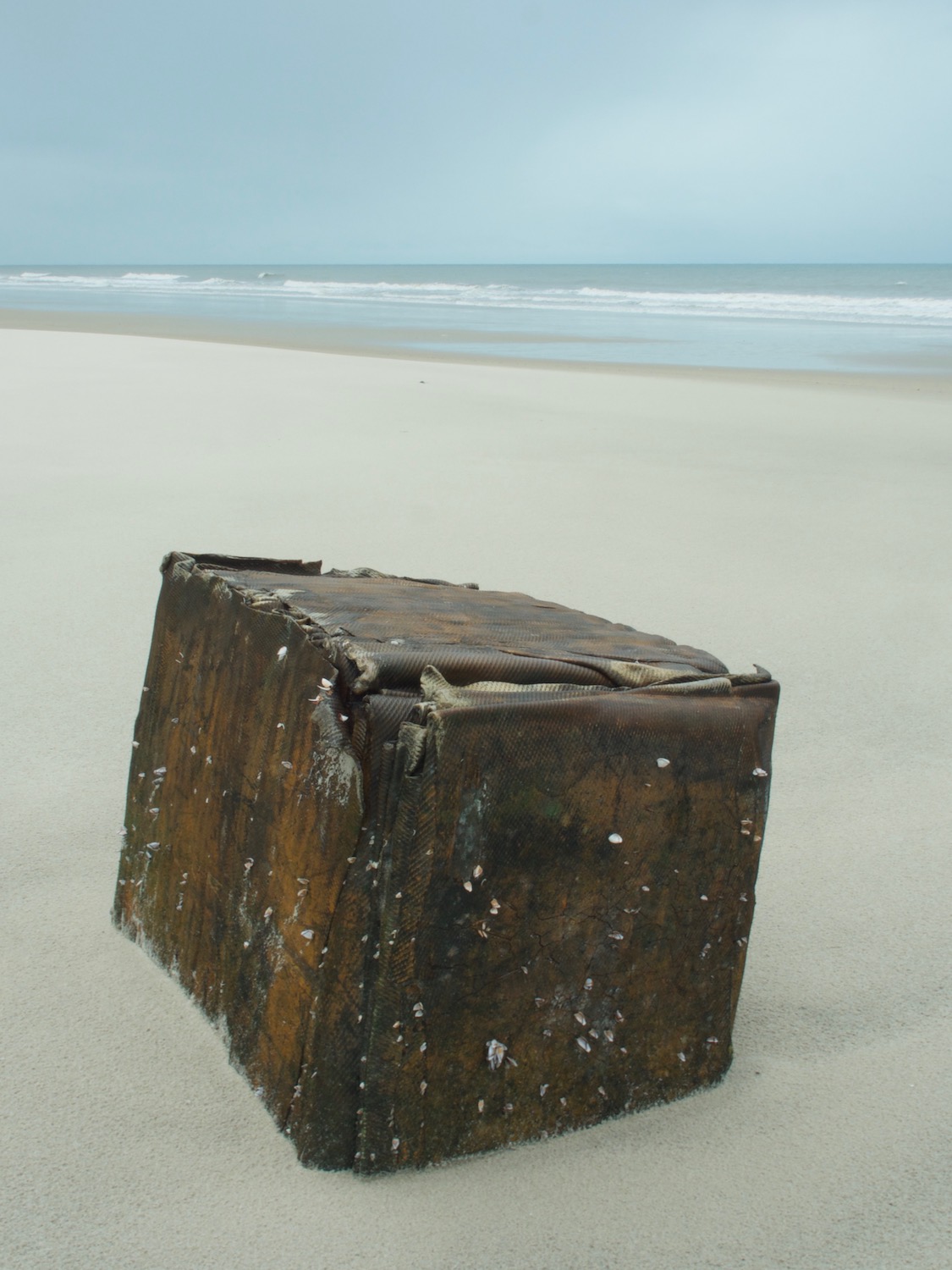
Latex is a valuable commodity and was especially so during the 1st and 2nd World Wars. Thousands of British, Japanese and German merchant ships and submarines were lost or sunk during the war years, many of them carrying a cargo of rubber. Bales have been washing up on European beaches for years and in some cases, it has been possible to link the rubber to specific shipwrecks.
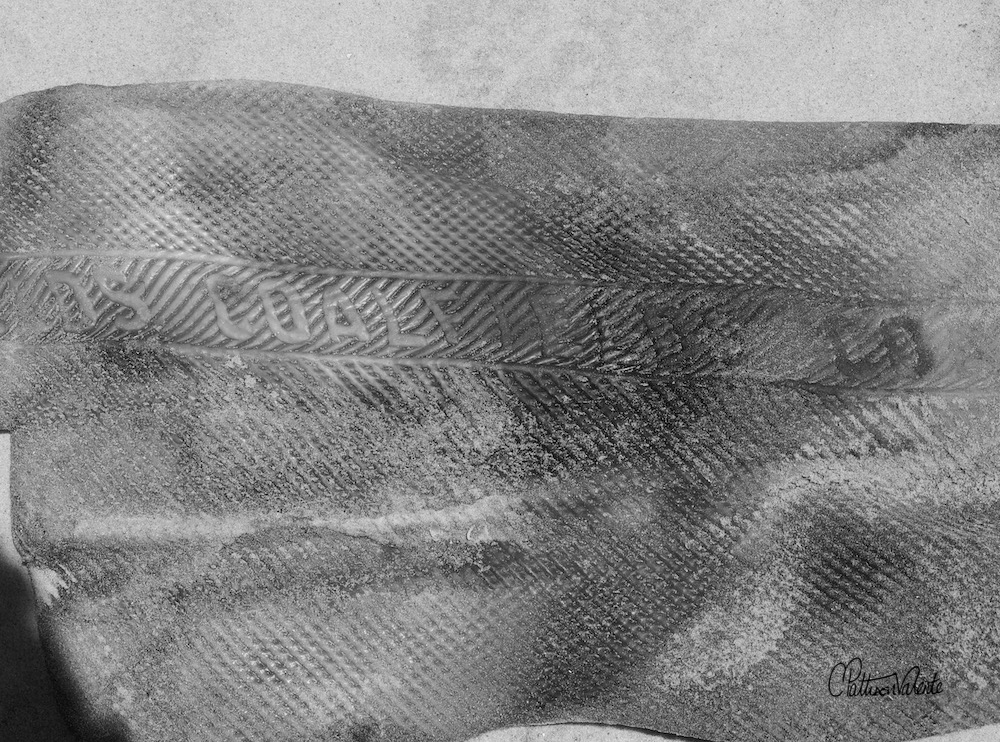
Shortly after I posted the original post about the mystery bales, I found a bale with “COALFIELDS” stamped into it. I couldn’t find any record of a plantation by that name. However, a Malaysian company called KLK, plantation owners since 1906, have developed some of their plantation land into two residential areas called Desa Coalfields & Seri Coalfields, both in Selangor, Malaysia. It is a bit of a leap but perhaps this rubber bale came from a plantation that was in one of these areas.
I knew that before washing up on the beach here, the bales had been floating in the sea for some time because many were covered in goose barnacles, a surface living crustacean. Putting all this together, I concluded that the bales were probably latex rubber and probably from a 1st or 2nd World War shipwreck but that was as far as I could go.
Part 2:
Recently, I have been in touch with Professor Luis Ernesto Arruda and his colleague Professor Carlos Texeira, from the Institute of Marine Sciences (LABOMAR) at the Federal University of Ceará.
The Professors, working on their theory for the source of the bales, made a video where they discuss their discoveries so far. Luis has permitted me to use screenshots from the video to illustrate their findings. If you understand Portuguese, you can see the whole video here.
In July 2019 Luis found a single bale with “PRODUCT OF FRENCH INDOCHINA” stamped into it. French Indochina was a French colony from 1887 to 1954 and consisted of Cambodia, Laos, regions of Vietnam and the Chinese territory of Guangzhouwan. French Indochina came under the control of the Japanese from 1940 to 1945.
Professor Carlos and Professor Luis were able to link the bale to the SS Rio Grande, a German merchant ship sailing from Singapore to Europe, sunk off the coast of Brazil on 04/01/1944 by the Cruiser USS Omaha and the Destroyer USS Jouett.

Navel communiques stated that the ship was carrying French Indochina rubber. As the bales I found came from Malaysia, it would make perfect sense for them to be part of the cargo too.
The exact site of the Rio Grande was discovered on the 28th of November 1996 by Blue Water Recoveries Ltd (UK). Approximately 1000km off the coast of Pernambuco, lying at a depth of 5,762m (18,904ft). At that time, it was the deepest known shipwreck.*
The LABOMAR Professors made a mathematical model for the direction of travel of bales coming from the ship and the result was a perfect match for the location of the bales on the beaches of the NorthEast coast of Brazil.
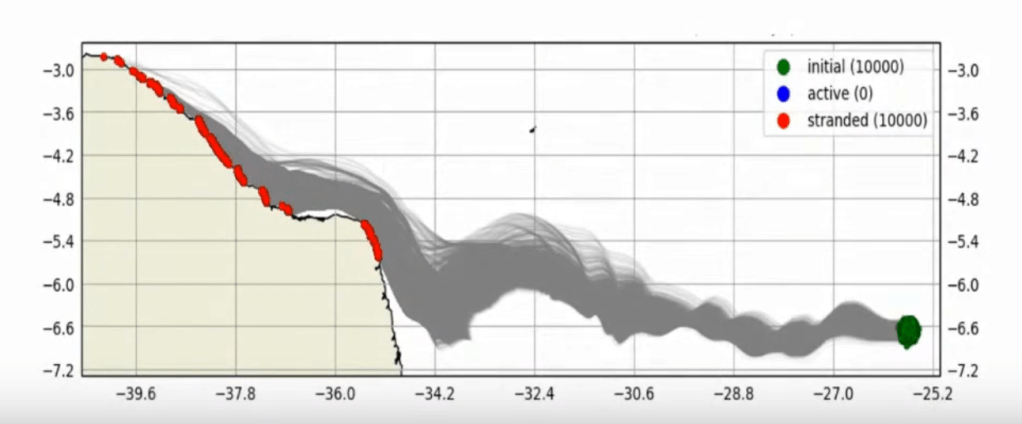
The Professors contacted David Mearns of Blue Water Recoveries, who provided an underwater photograph of the wreck, where bales of rubber are clearly visible on board the ship. This evidence, together with the mathematical model has left both Professors confident that the Rio Grande is indeed the source of the rubber bales. They are currently working on a documentary with another team from LABOMAR which, they intriguingly say, will unveil further evidence.
From here I went back to the internet to see what I could find out about the SS Rio Grande and I will write about that in Part 3 of this story.
Shortly after the rubber bales began appearing on the beaches here, those same beaches suffered a large quantity of oil washing up. The source of this oil is still unknown but it seemed entirely logical that if the Rio Grande had begun to break apart, allowing the release of hundreds of bales of rubber, then perhaps a shipwreck (if not the Rio Grande then some other) could have broken up and released a cargo of oil.
Carlos and Luis made another mathematical model for a ship called the IC White, a Panamanian tanker carrying 62,000 barrels of crude oil, that was sunk by a German U-Boat about 500 miles off Recife on 26th Sep 1941.
Although the mathematical model did match, they had to eliminate the ship as the source of the oil on the beaches, when a chemical analysis showed an additional substance which only came into use from the 1980s onwards.
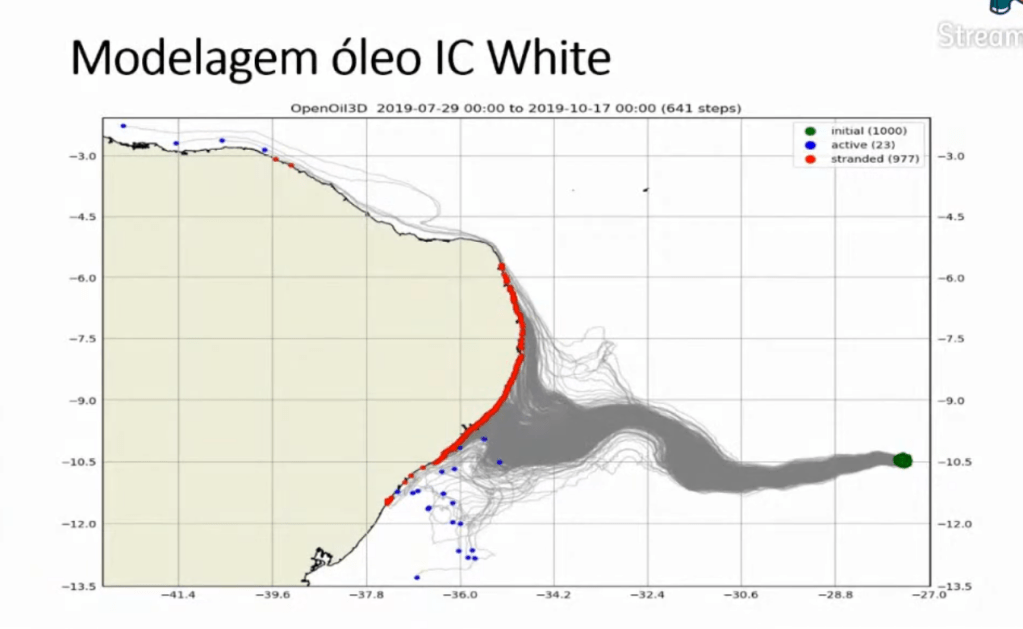
It would seem that the rubber and oil arriving at more or less the same time was purely coincidental. However, the oil that went down with the IC White is still down there and still represents a risk and that is something else I will be writing about in the next part of this story.
Notes and resources:
- On Oct 30th 2019, Paul Allen’s Vulcan inc announced the discovery of what they believe to be the USS Johnston, in the Philippean Sea. It is now the deepest known shipwreck at 6,220m (20,406ft) .
http://www.ibiblio.org/pha/comms/Communiques.html
All text and photographs my own ©Claire Pattison Valente, unless otherwise stated.
 The English Woman's Blog
We have A lot of oil covered items lately as well as the bales!!!!
LikeLike
Oh dear Diane, that’s not good, though I guess not surprising, as with the bales, the current will take it your way. If it’s any consolation we haven’t had any more oil washing up for some time now, hopefullyyou won’t get too much more.
LikeLike
Pingback: Mystery bales. | The English Woman's Blog
Fascinating. Being a natural product i am surprised the rubber is in such pristine condition. I wonder if they could still be processed into Tires ..
Regards, Patrick from Melbourne
LikeLike
Hi Patrick. Some of the bales that washed up here were a bit worse for wear but under the outer layers the rubber looked fine. They know from the barnacles on the bales, that they had been on the surface for at least a month before they washed up and as they arrived in such quantities, it is assumed they were released into the sea at the same time. If they had been packed in together in the hold of the ship, there would have been no light or oxygen to degrade them and their exposure to seawater might have been limited too. The ship could have broken up, therefore releasing them or, there is a possibility that there has been unofficial salvage work carried out on the wreck by persons unknown seeking her more valuable cargo, the rubber would have been of no interest to them.
As to its reuse; someone did come here and offer the fishermen a sum of money for each bale found and they do still appear from time to time, though rarely make it to the beach as the fishermen collect them out at sea. What the man intends to do with the rubber I don’t know but one of the professors from LABOMAR told me that the rubber is of a very high quality.
I am writing about the ship and how she came to be wrecked off the coast at the moment, I hope to post it on the blog soon.
Cheers, Claire
LikeLike
I just found a bale yesterday on Gower coast, UK. Im going to go and inspect and take photos today.
LikeLike
Hi Jem, I’d be interested to know if you find out anything about where it came from. I know some washed up in Cornwall some years back, it could be from the same ship, though I would imagine a lot of rubber went to the bottom during the war.
LikeLike
I found a bale on the North Devon coast today too.
LikeLike
Hi Claire,
I just noted the website was updated since my last visit? However, I’m in rubber and latex (foam) and would like to talk to the scientist in Brazil who checked the ribber bales. Do you sill have any contact alive and could share?
Regards, Jens (js at latexfoam.technology)
LikeLike
Hi Jens.
The only contacts I had was with the professors from LABOMAR, Professor Luis Ernesto Arruda Bezerra and Professor Carlos Eduardo Peres Texeira, you can find their contact details here https://labomar.ufc.br/pt/sobre-o-labomar/servidores/professores/
I do not know if they analysed the bales, I believe that work was done by others but I’m not sure.
Some bales also washed up in Florida and it is believed they came from the same source. You might be able to find out some more by searching for American studies carried out on them.
Hope that helps.
LikeLike
hi. I don’t have the rubber bales but I can find who I gave them too if needed
LikeLiked by 1 person