Tags
artisanal boats, artisanal fishers, boat building, Coastal sailing, Jangada sailing, Jangadas, life after kidney failure, New boat
This was before the lockdown from Covid-19.
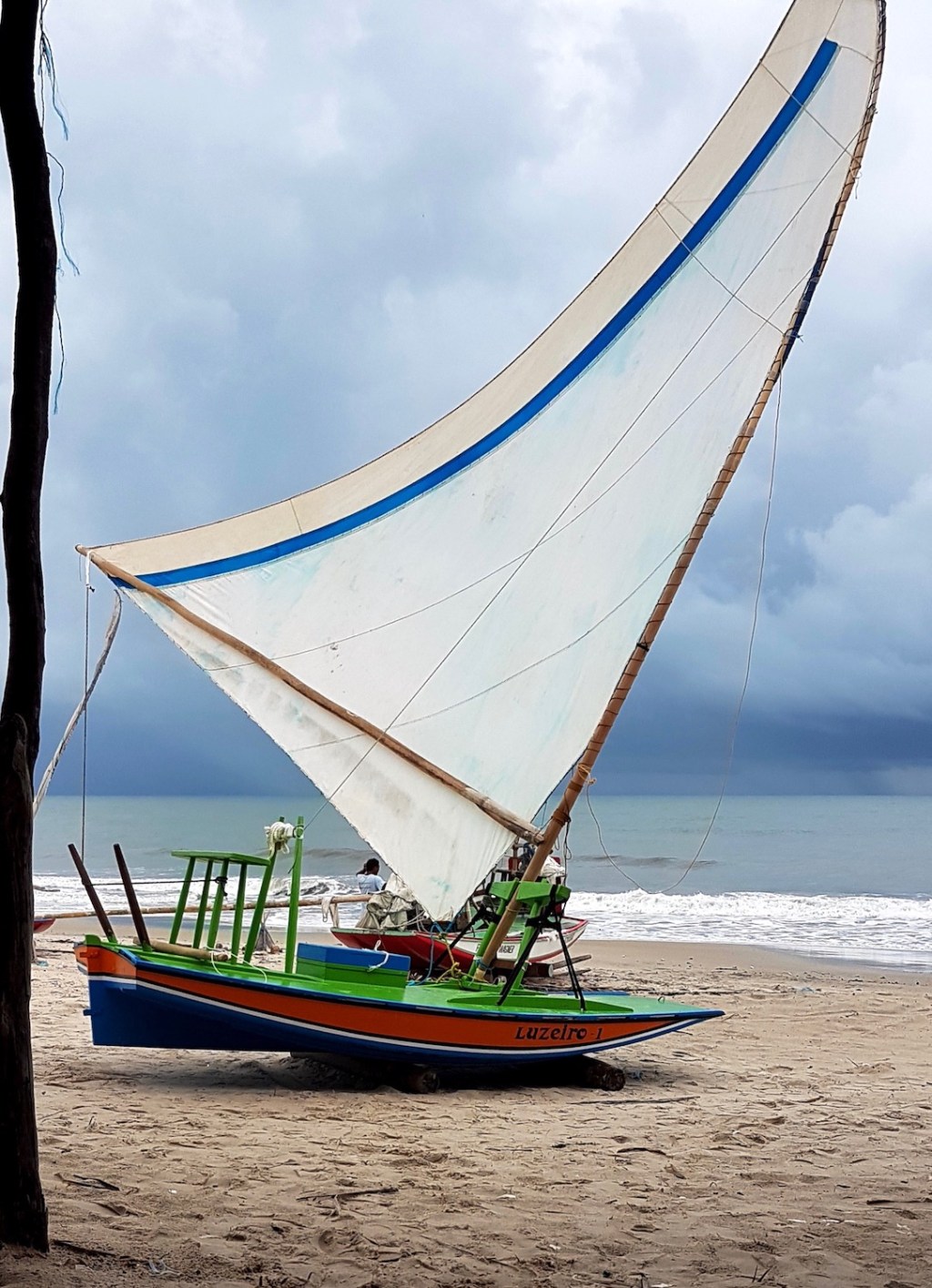
In the middle of 2019, Neu decided that his jangada (a traditional raft-like sailboat) was simply too heavy for him to operate. The fistula in his arm that he uses for dialysis needs to be cared for and that means not using too much force with that arm, he hoped that a new, lighter jangada, one made of marine ply covered with fibreglass, would allow him to fish more frequently.
Although some people think Neu is mad to want to go fishing, it is very much a part of who he is and the belief that he will one day be able to return to the profession that he loves, if not full time then at least when he can, has kept him going through some very, very dark times. So, in June 2019 Neu sold his old jangada and commissioned the new one to be built in Fontainha, a small fishing community along the coast from us where Neu has family, and was meant to be ready by Christmas. As is often the way, time ticked on and it wasn’t until the beginning of March 2020 that we finally got the call to go and collect the boat.
As it’s my birthday in March, as a sort of birthday present Neu asked me if I would like to sail the boat back with him. The Jangada is only big enough for two people and so I was a little reluctant at first, I can do the basics on the boat but if anything were to happen to Neu, it could be tricky. Neu said his cousin, who lives in Fontainha, would be sailing his own boat back to Prainha, so would accompany us and anyway, we would only go when it was calm. It’s been a long time since I’ve been able to go sailing and reassured on the safety front, I was happy to take up the offer.
As the crow flies, the distance from here to Fontainha is about 49 km, however by road, it’s roughly 70 km and the last part of the journey is over a dirt road that can, depending on how much rain we’ve had, be full of huge potholes that are difficult to get around, it makes for slow going. To be there early enough for the morning tide, we would have to leave here in the dark of pre-dawn.
We set off at 4.30 am, arriving in Fontainha just after sunrise. The boatbuilder had told Neu he would meet him on the beach but apart from one man who was getting a small boat at the waters edge ready to put to sea, the beach was empty. We walked up the beach a bit until we spotted the new boat and as we began to look it over, the man with the small boat came over for a chat, then offered to go and let the boat builder know we had arrived.
In no time at all a small group was on the beach, all busy offering advice and preparing Neu’s new jangada for its maiden voyage. Neu’s cousin had apparently already gone fishing and so would not be travelling back with us after all. I wasn’t too happy about that bit of news but Neu said that it was such a calm day it would be fine. I trust him and his knowledge of the sea completely and frankly I couldn’t bear to disappoint him by saying I wouldn’t go, it would have meant a further delay in getting his boat back.
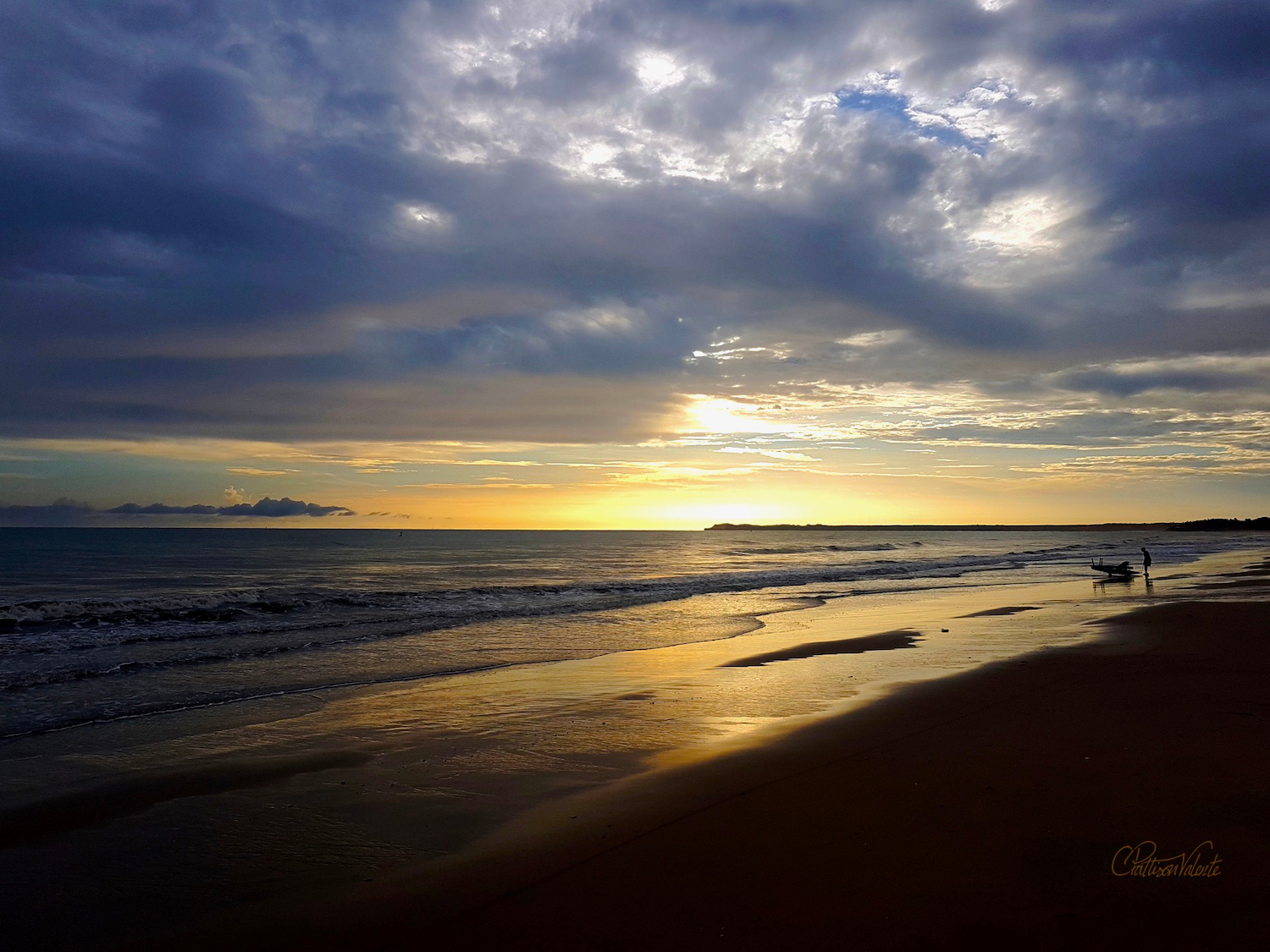
We left the beach at 7 am, with the help of a local man who pushed us out through the gentle breakers until he was chest-deep in water, then we slipped away like a hot knife through butter. The paint job on the boat deck was as smooth as glass, it made the normal way of standing on the very edge of the deck difficult, I didn’t fancy sliding off. Something will have to be done to make it rougher, it is important to be able to balance on the edge, it helps keep the underside in greater contact with the water, but that work will be for another day. Smooth deck aside, Neu was so happy, he’s not a great one for showing his emotions but I could tell his heart was lighter, there is nothing better for him than being on the sea and to be out on a new boat is just perfection.
For the days leading up to this trip, I had been asking the elements to give us calm weather and I think I may have overdone it. We had only gone a couple of kilometres when the wind died away completely, not a whisper, we were virtually stalled in the water. Soaking the sail helps to trap any wind but no matter how much water we threw at it, there was no wind to catch and we were making painfully slow progress. Now the sun was up and there is no shade on a jangada, nowhere to hide, I soaked an old T-shirt and wrapped it around my feet to protect them from the sun and help cool me down.
The water licked the side of the boat as we slowly rocked and swayed, the rudder creaking in its housing, the wood of mast and boom gently knock knocking. Neu re-soaked the sail again and again, causing cooling cascades on the deck as the water fell away but there was still barely a ripple on the water. After 6 hours we had only made it as far as Canoa Quebrada, meaning we’d only covered a distance of about 15 km. We were making roughly 2.5 kilometres an hour, at that rate, it would be quicker to walk!
We began to discuss if we should land the boat somewhere and ask our friend to come and pick us up, at the rate we were going it would take us about another 14 hours to get home but we decided to keep going until we passed Maseio, this would be about halfway home and we would decide to go on or not depending on what time we reached there.
The early start to the day, combined with the gentle rocking and the heat were encouraging a headache to grow. From experience, I know that the best way to avoid it taking hold, or worse developing into seasickness, is to sleep. The deck of a jangada isn’t the most comfortable place to lie down but the life jackets made a good enough bed and I slept for an hour or so, feeling considerably better when I woke.
Knowing that Neu really wanted to get the boat home today, and a bit worried about how his system would be coping with all this, I began whistling for the wind. This is something Neu taught me to do many years ago, the fishermen believing that if you whistle it calls the wind in. Neu joined me and in no time the wind answered our call. Unfortunately, it was coming from the North, which wasn’t that helpful as it was pushing us towards the coast, just as we were approaching Maceio where there are large numbers of rocks underwater and where the last thing we wanted was to be closer to the shore.
We were far closer in that Neu wanted us to be and could see areas where the waves were white-capped, demonstrating that they were breaking over rocks. Neu asked me to keep an eye on the water immediately in front of us, as he steered us through the channel, adjusting the sail every few minutes to keep us on course. It was a tense half-hour but we made it through and Neu could relax again.
Now the wind was more helpful and with the increase in our speed, we decided to continue on home. We knew we wouldn’t get back that quickly but hoped we’d arrive off Prainha before it was too dark. Sunset here is a very fast affair, no slow deepening of the dark, it’s more like someone has flicked a switch, the sun goes down and in moments it’s pitch black.
We had been snacking on crackers and fruit but with the heat and slow pace, neither of us had felt really hungry until now. Knowing we were in for the long haul, Neu asked me to take over the helm so he could make us a late lunch. When the men go fishing, often going away for up to 5 days at a time, they take a charcoal burner and a pan to cook their food. A lighted match is put to the husk of a coconut, this catches fire quickly and makes an excellent firelighter for the charcoal. In no time a fire is burning and when it’s hot enough on goes a pan of water with some freshly caught fish (though we had bought the fish with us). After a few minutes cooking, some of the liquor is added to a portion of farinha (course cassava flour) which swells and thickens like porridge and that, with the fish gives you a very basic but very tasty, and importantly, very filling fish stew.
Thankfully, the second half of our journey went by much quicker than the first. I was delighted that Neu left me to steer us home, I love sailing the jangada and can understand why the men are so passionate about their boats. We arrived off Prainha just as the sun was setting. It can be tricky getting onto the beach, it’s not uncommon for jangadas to turn over at this point if a wave catches them badly, so Neu took over the helm to take us in. We landed safely at 6.30 pm, just as the last of the light left the sky. A group of Neu’s friends were waiting for us, all wanting to see the new boat and give an opinion on it, going over it by torchlight. Having landed on the beach, the boats have to be moved up to the dry sand, the guys set about doing that while firing a hundred and one questions at Neu about the boat and the journey.
By the time we got back to the house, it had been a very long day, fifteen hours since we’d left in the morning and eleven hours of sailing from Fontainha to Prainha but it was fun and Neu was the happiest I’ve seen him in a long while. Fingers crossed he will soon be well enough to go fishing more regularly on his new jangada.
A short video of our journey
 The English Woman's Blog
Lovely video of your journey.. you must have both been so relieved when you made it back. Well done and hope Neu gets back to sailing soon. Take care both
Monica x
LikeLike
Hi Monica, thank you and yes it’s always good to get back safely but I do love the adventure of it all. Hope you are well and not going stir crazy with the lockdown x
LikeLike
We’re both well thanks.. quite enjoying the time it’s given me to do the things that have been on a list for a long time! I’ve been working some hours so not quite 7 weeks off but Mark hasn’t done any work are the cab trade in London is dead. Looks like you are well away from the London life and being stuck indoors . Take care and look forward to reading your next update 🙌x
LikeLike
I love your blog Claire. It’s such a long time since we were in Prainha, but I just love feeling like I’m back there briefly. I can picture the new Jangada on the beach near the round house where we stayed. Especially good to have an escape in these strange lockdown times. All vest to you and Neu!
LikeLike
Hi Kitty, how lovely to hear from you and thank you for your kind words. Change is inevitable I guess and Prainha remains a beautiful place but I’m not sure you would recognise it now, there has been a lot of building work down near the beach and at the same time a lot of coastal erosion. I’m afraid the round house is long gone, eaten by the sea along with many of the other beach front homes but the beach remains that glorious stretch of sand. Much love to you and your family, hopefully these strange times will ease soon x
LikeLike
All BEST!!!
LikeLike