Tags
Beach clean up, borracha no praia, Flotsam, Ocean clean up, Prye Estate., Prye rubber and coconut plantation Malaysia, Rubber bales, Senawang, Tjipetir, Wrecks
What we discard just goes, or in this case is still going, somewhere else.
There is an update to this story which you can find here
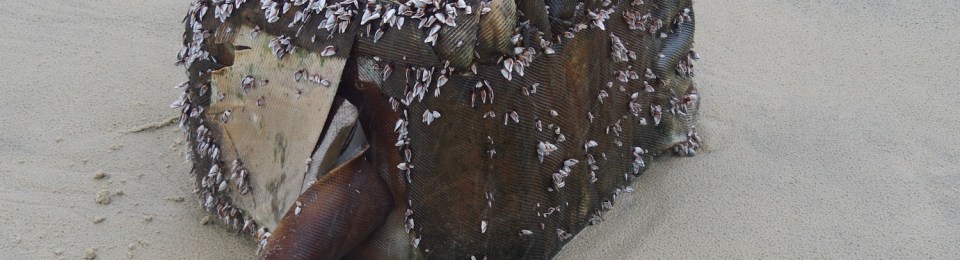
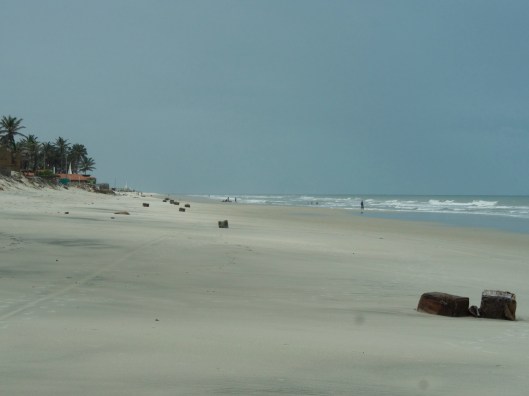
A couple of days ago, Neu and I went for a walk on the beach. I was astonished to see these large blocks, dotted along the whole length of the beach, for as far as the eye could see. They were fairly well spaced apart but Neu said that further up the beach (just out of sight in the first photo) there was a huge collection of them.
Not knowing what they were made of, I was reluctant to touch them but took some photos, which I later posted onto a Facebook group I belong to. The Nature & Beach Clean Up Group (Worldwide) is a group that is depressing and inspiring in equal measure. Depressing, for the constant examples of accumulated rubbish in the environment. Inspiring, for the truly amazing people who constantly make the effort to clean it up. I was pretty sure someone there would be able to shed light on what these blocks were, and I was not disappointed.
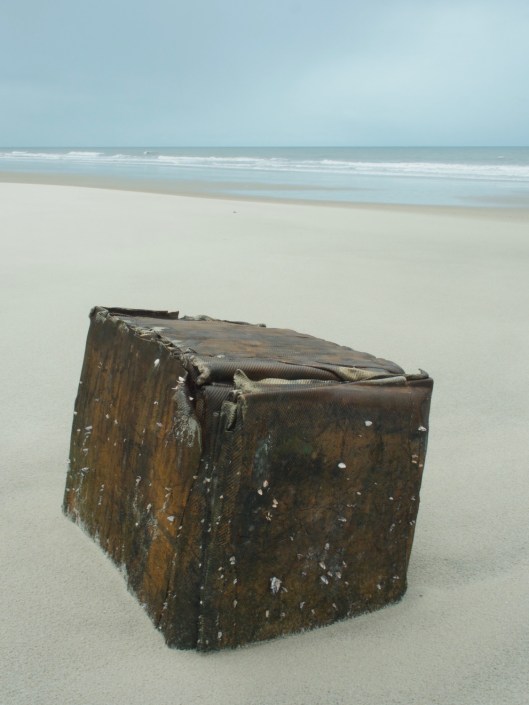
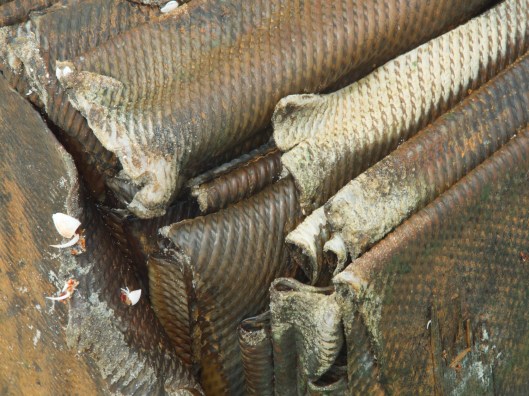
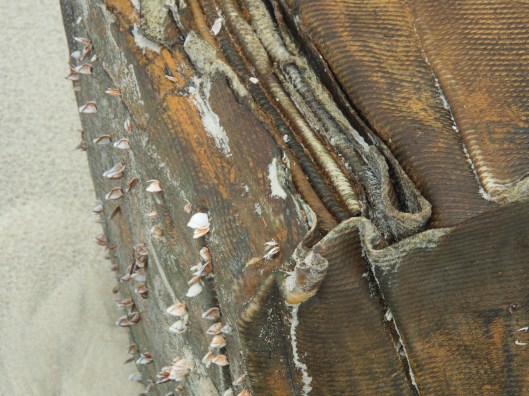
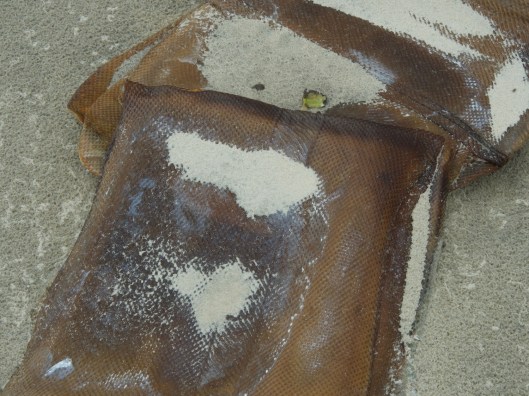
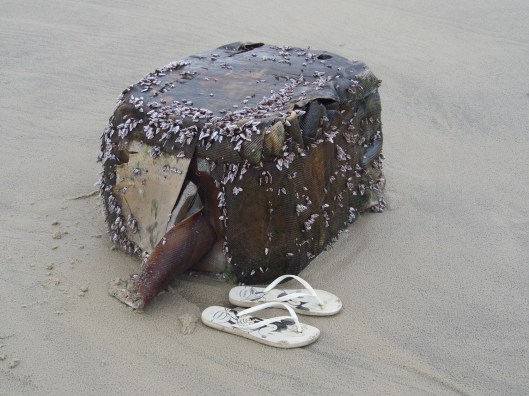
One of the first links I received was to an article by the BBC about The Tjipetir mystery, Blocks stamped with TJIPETIR and rubber bales have been washing up in small numbers on British and European beaches for years. Rumours had these coming from the Titanic, which was known to be carrying rubber as part of the cargo. However, the article reports that research done by Tracey Williams and agreed with by The Receiver of Wreck* has the most probable source as the Miyazaki Maru, a Japanese ocean liner, sunk by a German submarine in 1917 near the Scillies. The ship is known to have been carrying a cargo of rubber bales and blocks of gutta-percha.
According to the article, the Oceanographer Curtis Ebbesmeyer (the man who studied all those little plastic ducks that went bobbing about in the oceans for years) says that “It only takes 25 years for flotsam to go around the world …” and that it is possible that ocean currents could take the bales in the direction of the Americas, “mirroring the same route that Columbus took”
However, the chances of the bales on the beach here, coming from that specific wreck are pretty slim. The rubber trade has a very long history and no doubt many vessels with a cargo of rubber have sunk over the years, especially during the 1st and 2nd World Wars.
Looking through the National Archives (UK) I came across War Risk Insurance Records for the 1st World War, with at least 4 payouts in 1917 for lost rubber cargo. I would imagine many more ships went down with a cargo of rubber in World War 2, though I was only able to find records of a German submarine that was sunk in 1943 and a Japanese submarine, the imaginatively named I 52, that was sunk in 1942. Along with the rubber, the I 52 was carrying gold, wouldn’t it be nice to find a lump of that on the beach.
My father-in-law, now in his 80’s, says that similar bales washed up here when he was a teenager. At that time, men came to collect them and warned the locals not to take the bales, that anyone found in possession of them would be in trouble. Whether these men had a legitimate claim to the rubber is anyone’s guess.
Knowing the time it takes for flotsam to travel the world in the oceans currents and knowing, from their covering of goose barnacles, that these bales have been on the surface of the sea for some time, it is possible that these are the same bales, coming back round again.
Another link given to me from someone in the Facebook group was to a report in the Brazilian press which says that large numbers of bales have been washing up along the coast of NE Brazil, on beaches from Piaui and Ceará to Alagoas. The report also says the origin of the bales is unknown and that they are a “plastic rubber” (petroleum based rather than gum rubber) which if true, is more worrying for their impact on the environment.
One of the other links I found was to a fascinating collection of photographic sites called APHOTO by David Fenwick (for those of you interested in the Flora and Fauna of the UK go check it out, it’s a huge body of work and a wonderful resource). On APHOTOMARINE, there are photos of rubber bales, showing the name SENAWANG that washed up in Cornwall in 2016.
I hadn’t noticed at the time, but after looking at the photos by David Fenwick, there is a possibility that one of mine also shows a name but it’s not clear enough to be certain. Yesterday I decided to go back down to the beach to see if I could find a name stamped into any of them. That would certainly help to identify if they are a latex or a chemical rubber and maybe from whence they came.
I was thwarted in my efforts for two reasons. Firstly, the sea had taken back most of the bales and secondly, a heavy rain storm reached me at exactly the same time that I reached the closest remaining bale. We have been having really powerful thunder storms lately and while I don’t mind getting soaked, I don’t fancy being struck by lightning. I momentarily wondered if sitting on a rubber bale would keep you safe from the effects of a lightning strike but wasn’t about to test that theory out.
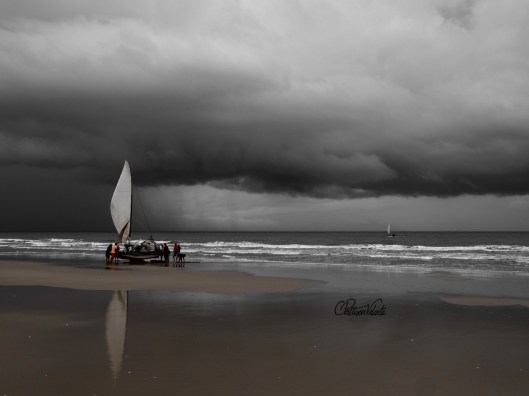
As I’m writing, my son has just come back from the beach. He could only remember seeing one bale left, though he was there to go surfing with his friends, so wasn’t really looking out for the bales and couldn’t say if there were others further up or down the beach.
It is obvious that the sea is moving the bales on again. A stark reminder that what we discard just goes, or in this case is still going, somewhere else.
Update:
I posted this a couple of hours ago and then went out for a walk with my son. We were heading to a lagoon but went via the beach, just to see if we could find a name on a bale. There were four or five bales but non of them had any identifying marks. We could see one more, a little way off and decided it would be the last one we would check. Low and behold, it had the words PRYE ESTATE stamped onto it.
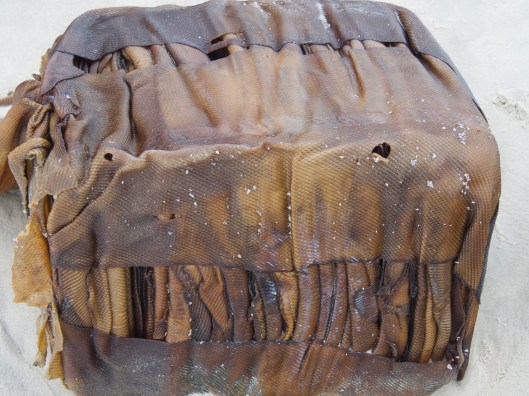
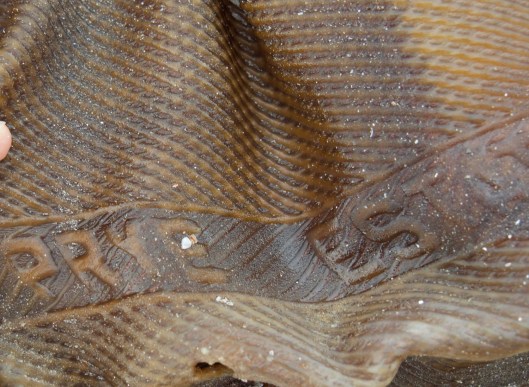
Prye Estate was a Rubber and Coconut Plantation in Malay, now Malaysia. The plantation no longer exists and the land where it was, is now built over. The only information I could find on the Estate was: a quote from a letter sent by the estate manager 1879; an inquiry about a plantation manager who worked there in the 1930s and a record that the Penang Government bought the Prye Estate in 1967 to develop the industrial site that now covers it.
So all I can say is that the rubber on the beach was produced sometime between 1879 and 1967. I still cannot say for certain that it is a natural gum rubber, though I suspect that it is. Of course the cargo could have been a mixture of rubber from different sources, some natural, some not. I’m no closer to solving the mystery of which ship they came from but it’s been fun finding out what I have.
There is an update to this story here:
*The Receiver of Wreck or Coroner of the Seas is the guardian of Britain’s offshore wrecks.
 The English Woman's Blog
Recently hundreds of these rubber boxes have been washing up on the northeast beaches of Brazil. I foud a pretty much intact box, it says something on the box but I can’t read the first letters just the last ones which says: 400NET. I took some pictures of it
LikeLike
Hi Matheus, thank you for your comment. I am also in the northeast of Brazil, near Beberibe, Ceará. I also found bales with words I couldn’t read but non like you describe. I read today of the possibility that the bales and the oil which, as you probably know, has also been washing up on the beaches here, may come from a German ship that went down near Recife in 1941, though this hasn’t been confirmed. Hopefully one day we will find out.
LikeLike
We are finding the same bales, a bit more degraded and no visible markings, here on Palm Beach, Florida. 3 for sure.
LikeLike
Hello Diane, thank you for letting me know. At the moment I am working on a new post about the bales and some more things that I found out after speaking with the team from LABOMAR, from the University of Ceara, who believe they have identified the shipwreck that the bales here (and perhaps yours) have come from. I will pass your information onto them too. Thank you.
LikeLike
Pingback: Mystery bales continued. | The English Woman's Blog