This blog is about my life here and all the differences I encounter. The approach to death and funerals is one such difference. It took me a while to post this as grief is a private thing and I needed to be sure that Neu was ok with me writing about the sudden sad death of his mother.
Sunday the 10th of June. Mid morning.
Neu came back from his parent’s house next door, saying that his sister had taken their mother to the local hospital. We were not overly concerned as, with no doctor in the village, it is normal for people to go to the local hospital for relatively minor issues. Donna Raimunda had an infected tooth, for which she had been given antibiotics earlier in the week. We knew she blamed them for the aches and pains she had developed and assumed she had gone for some alternative treatment. We later discovered that she had stopped taking the antibiotics on the Friday night. It is probable that doing so, caused her situation to be far worse than it might otherwise have been.
At the hospital, Donna Raimunda was diagnosed with pneumonia in both lungs. The doctors warned my sister-in-law, Lineuda, that Donna Raimunda’s situation was serious. They would begin treatment but could not know how she would respond. SAMU (the emergency medical ambulance service) were on hand and would soon transfer her to an intensive care unit in a hospital in Fortaleza.
An hour or so after treatment began and whilst still at the local hospital, Donna Raimunda suffered a cardiac arrest, caused by toxic shock due to pneumonia. All efforts by the doctors and SAMU team failed to revive her and she was pronounced dead at 1pm.
We do not get a telephone signal at the house, so Lineuda sent me a message via a neighbour. The neighbour didn’t know if Jola (Neu’s older brother) had been told yet. As Neu was having a siesta, I thought it best to fetch Jola before telling Neu or his father.
Jola’s house is a couple of hundred meters away and I met him on his way to us, he’d already got the news. We returned together, both fearing how Neu and his father would react. Out of Donna Raimunda’s three children, Neu was the closest to her and his heart is already under undue strain because of his medical condition. Neu’s father is an old man and they had been together for nearly 50 years. Anyone who has lost a parent or long time partner, especially so suddenly, will understand how devastating it can be when that emotional rug is pulled out from under you.
I have written before on the speed that news travels around the village and news of a death spreads like wildfire. It seemed only minutes after I had told Neu and his dad the sad news, that people started to arrive at the house.
The process of a Catholic funeral here is maybe not so different to the way things are done in other Catholic countries, but not being Catholic, I once again found myself in a situation for which culturally I was completely unprepared.
It is customary here for the body to be laid out in the house, people come to pay their respects and view the body. The funeral takes place in the early morning of the day after the death, I assume this is because of the heat.
Now mid afternoon, as we waited for the funeral company to bring Donna Raimunda’s body back to the house, more and more people arrived. Donna Raimunda was a descendant of one of the founding families of the village, therefore she was related to pretty much everyone in one way or another. I expected that soon the house would be packed to the gills.
Someone delivered a load of plastic chairs and people set about making coffee and a sweetened tea from Capim Santa (Lemon grass). More people arrived. As I didn’t know the procedure, I didn’t know what, if anything, was expected of me. It was a little overwhelming. Normally, when I find myself in some unknown situation I ask Neu but this was one time when I couldn’t. We sat together holding hands on his parents old sofa, Neu lost in grief.
Still more people were arriving, filling up the lane outside the house for lack of room inside. Neu’s father, a man who always loves to tell a story, was deep in animated conversation with his friends. It fell to Jola to go and see the man who would dig the grave, which would be in the larger neighbouring community of Paripueira. Prainha does not have a graveyard. When Jola left, Neu asked me to go back home with him.
We got another message from Lineuda. The funeral home had told her that, due to the cause of death, Donna Raimunda’s body would have to be embalmed. This was an added cost that her funeral plan did not cover, I’m not sure what would have happened had we not been able to find the extra R$500. Poor Lineuda now had to accompany her mother’s body to the city where the procedure was carried out. What an awful day for her this had been. We were told to expect them back in the village between 8 and 9pm.
People arrived at the house all afternoon and evening. Some people in tears and then, after a hug from someone, all smiles again. The atmosphere was of a congenial gathering and it struck me that Donna Raimunda would have been thrilled to bits with the turn out for her, though somewhat miffed that she couldn’t join in the conversation.
The funeral large 4 wheel drive vehicle arrived around 8.30pm. I could only see a lot of equipment, chairs and other items in the back. Someone in the house told me that this was not the car with Lineuda and her mother, they would come on later. A young woman came in with the driver, she was dressed as a nurse (though I don’t know if she actually was) and carried a blood pressure monitor in one hand and in the other, a small canvas bag marked with the funeral company logo. She handed me the bag and then set to work checking the blood pressure of those who wanted it done. I wasn’t sure what the bag was for. On opening it I found some coffee, sugar, rice, crackers and farinha (a food staple here), a little gift from the funeral home.
A room in the house had been cleared of all furniture. The funeral man with the help of some of the visitors, brought in the funeral items. Heavy metal supports to take the coffin. To stand at the head of a coffin, a large ornate crucified figure of Jesus on the cross with two, tall white candles on either side. On the wall was hung a large cellophane wrapped wreath of paper flowers and by the door, a tall stand with a visitors book to be signed. Unfortunately it was some time before anyone realised there was no pen, so quite a few people left without signing the book. In rural communities such as this, there is a high level of illiteracy amongst the older generations, I am sure many a visitors book goes thinly signed.
The neighbour who had given me all the messages earlier in the day, appeared by my side, she whispered that the coffin was indeed in the vehicle and Lineuda was also there, unable to face all the people in the house. I went out to the car and found her hidden from view on the other side of it, being comforted by our lovely friend Marlene. While everyone was focused on the comings and goings of the funeral staff, Lineuda and I slipped away to my house, where we met up with her younger adopted sister, Veronica, who had just arrived from her home in a nearby town.
Lineuda and Veronica were obviously in a state of shock. Being English, I offered everyone some tea. Not many Brazilian’s go in for English style tea but my sisters-in-law have grown used to it and were grateful. We sat sipping our hot tea, talking through events, trying to make sense of the day.
A little while later, the man from the funeral home came to sort out the inevitable paperwork. I was impressed by how kind he was, how considerate of the family and of everyone’s feelings, he certainly did his best to make everyone feel at ease during a difficult moment, hat’s off to him.
It was organised that the funeral car would return at 3pm the following day. Friend’s had offered that Donna Raimunda’s coffin be placed in their family vault in the cemetery in Paripueira. A service would be held in the chapel attached to the cemetery.
Once all the details had been arranged, tea drunk and nerves calmed a little, my sisters-in-law left through our back gate to go to Lineuda’s house (which is behind mine) to shower, change and prepare for the all night vigil. Some months back, Neu was prescribed sleeping pills, they came in handy now and I was glad he was fast asleep. I went to pay my respects to Donna Raimunda.
The coffin had been brought in to the room. Donna Raimunda lay in the open casket, her body covered in white chrysanthemums. The top half of the casket had a light decorative lace covering, with only her face and hands showing through the flowers. Someone mentioned that her finger nails still held a trace of nail varnish, I knew she would have hated people commenting on that. I went home and got some nail varnish remover and some perfume too, as I could imagine her wrinkling up her nose at the smell of the embalming.
We sat and talked through the night, with people gradually drifting away until it was only close friends and family. I left in the early hours of the morning, unable to keep my eyes open any more. My father-in-law and my sisters-in-law would be up all night, or for as long as they could manage.
It seemed I had only closed my eyes when I was awake again with the cockerels crowing and the sun streaming in through the window. So began another busy day with people coming and going all the time. I think just about the whole village turned out at some point or other, many people from outlying areas too.
At 3 pm the funeral car arrived. Neu, his brother and sisters and I went with friends in their cars. Neu’s father decided not to go, he had worn himself out staying up through the night. Other family members also stayed behind and, while I was slightly surprised, it was obviously considered quite normal and acceptable by everyone else.
At the end of the lane, on the main road out of the village, a coach was filling with mourners. I’ve no idea who organised the coach or how it was paid for but people were piling on. I noticed that no one was dressed up, I think Neu and I were the only people wearing anything dark, everyone else was just in normal day-to-day clothes.
We proceeded in slow procession to the cemetery in Paripoeira. The small plain chapel looked rather like a store-room, with stacks of plastic chairs lined up at the back, cobwebs hung from the ceiling and dust on the floor. People placed some of the chairs against either wall, then the coffin was brought in and placed in the centre of the room.
A bright and cheerful man bounced in carrying a pink plastic bag. Dressed in jeans and a T-shirt, his manner was of someone organising a fun day out rather than a funeral. “Who do we have here? A man or a woman?” he asked. I was a bit shocked until I remembered the funeral of a friend’s father where the vicar, who had met with the family in advance of the funeral and had all the details he needed, repeatedly called the deceased by the wrong name, leaving some of us to momentarily wonder if we were at the right funeral.
The cheerful man asked the family to sit, before asking who would sing and who would do the reading. As those willing identified themselves, he took out some photocopied sheets from his plastic bag and handed them round.
I have been reduced to a fit of giggles in a funeral service before, I know I’m not the only one, it happens. Sometimes it’s a deliberately planned funny moment, where it is fine to laugh, other times it’s purely situational, where to laugh might be frowned on. There were two points in my mother-in-laws funeral that nearly set me off, I succeeded in controlling myself but only just.
The first giggle moment came when we were asked to sing. I had volunteered but I’ve not really sung hymns since Primary school and never sung Brazilian ones. I figured I could get by with reading the words and the other singers for the tune. I quickly realised that this was not going to work. The singer with the loudest voice was intent on singing a vastly different tune from everyone else and off key to boot. I clocked the worried looks of other singers, who then raised their voices to compete, it sounded dreadful and I was in danger of the giggles. We massacred a second hymn but by the third, I gave it up as a bad job.
The second moment where I really struggled to keep my composure was when the jolly man said something about water. I hadn’t caught exactly what he’d said as he looked around the room, just that he was sure there would be some there, somewhere. With a sudden cry, he went to the back of the room and took a squeezy bottle of Brute deodorant off a high shelf. Now I really was confused. Back at the coffin he squirted the bottle over it in the form of a cross, I realised it was Brute Holy Water. I bit the inside of my cheek!
The deodorising Holy Water brought the service to an end. We followed as the coffin was carried out to the cemetery, which was not as simple as it sounds. The small cemetery was amazingly un-organised in it’s layout. We weaved our way through the tombs, coming to an abrupt halt where graves had been dug in the middle of a pathway, having to double back to pick up another path. There were chunks of cement and broken tiles all over the sandy floor, I got the feeling that people don’t visit their dead relatives often.
We reached the tomb that was to be Donna Raimunda’s final resting place. Now I understood where all the cement and broken tiles came from, as a tomb is reopened, the waste is just left behind on the floor. Some rather frayed bits of rope were produced and a group of men, balanced on top of the tomb and the one next to it, helped to lower the coffin. Following the instructions of the graveyard man, a little bit slower at one end, a little bit quicker at the other, and what ever they did, not to let go and drop the coffin. It all seemed very precarious and I was greatly relieved when it was safely lowered. We threw in some of the sandy soil and everyone applauded as is the custom here.
The heavy top slabs of the tomb were equally precariously manhandled back into place and the graveyard man began the job of cemented in, telling us rather unnervingly not to fear, that nothing would be getting out of there.
We said our final goodbye to Donna Raimunda and wove our way back out of the cemetery. The sun was going down and the temperature was finally cooling. The school had closed for the day and the children were going home, filling the street with their joyful chatter.
The 29th of June was São Pedro’s day, the patron saint of fishermen. At this time, Prainha holds a traditional event whereby people from the village take a statue of São Pedro from the church down to the beach. There it is placed on one of the jangadas which leads the others in procession out to sea for a blessing. Neu and I went with a friend on Neu’s boat Luzeiro and made an offering to the sea of some flowers from our garden for Donna Raimunda. RIP.
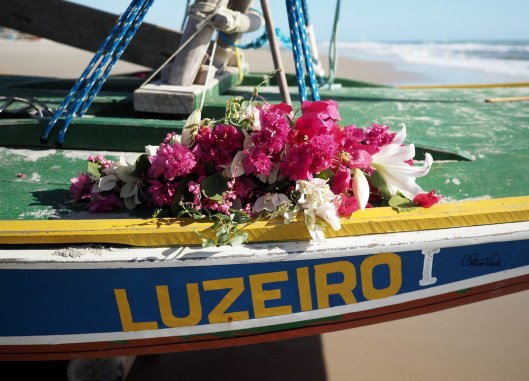
Flowers for Donna Raimunda
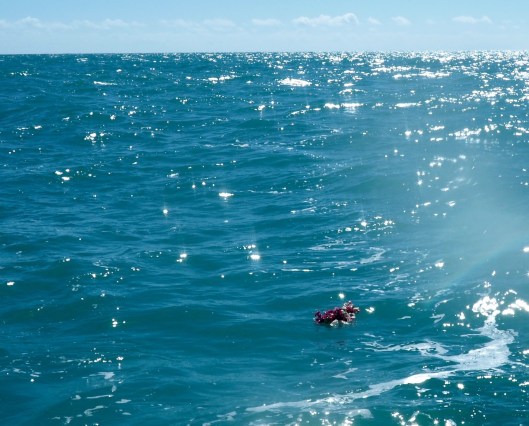
A final farewell
 The English Woman's Blog
Claire this is such a beautiful telling of a sad event I could almost image myself there. I send my prayers to you at a time of grief and sadness, especially as it was so unexpected. At times like this you must feel like a stranger in a strange land, but it sounds as if you are surrounded by a wonderful extended family. Community is such a rare thing these days. God bless you and those you love. Julie xxx
LikeLike
Thank you so much Julie for your kind and beautiful words xxx
LikeLike
Love reading your blog, Claire. You are a gifted writer and are able to portray your amazing life in Brazil so beautifully. Thank you for sharing it, it’s lovely to share it with you! Sue xx
LikeLike
Thank you so much Sue. I love writing my blog and it’s comments like yours that make the effort I put into it worthwhile. XXX
LikeLike