Tags
artisanal boat building, building a jangada, fishing in NE Brazil, traditional boat building skills
In 2005 Neu had a new jangada built, we named it Valente. I couldn’t do a post about it at the time because the internet was too slow to allow me to load the photographs, but now with a faster internet I’ve finally got round to it. The photos follow the process from day one, to launch day and show how the jangadas are put together using hand tools and a good eye (the only electric tool the builder used was a drill). Valente is a medium-sized jangada measuring just under 4 meters and is designed for a crew of two or three, on coastal fishing trips of a days duration. These smaller jangadas are filled with polystyrene to aid in buoyancy and have no sleeping / storage space inside, as is found on the larger boats (those above 4 meters in length) which are used for deep-sea fishing and crewed by four to five men (women do sometimes make up part of the crew). On deep-sea trips the boats will spend up to five days at sea, with the crew sleeping on the bare boards within the very cramped confines of the boat, here they also store all their cooking equipment, food and water etc. You will occasionally find a smaller jangada with this inner area but it is unlikely that it would be used for deep-sea fishing, the smaller jangadas being slower, are simply not be able to cover the necessary distance in a reasonable time.
The wood for Valente was bought and cut to basic shape in a wood yard of the local town, delivered to the village and then stored to season it. Neu employed one builder and his mate to do the main body of work but loads of friends and family members pitched in to speed the process and offer advice and opinions.
I tried to keep a record of costs but it seemed to me that we were forever having to return to town to buy more nails, paint, rope etc and Neu is terrible at keeping accounts, he just doesn’t see the point. Adding up what I know we spent and estimating the rest, Valente cost us nearly R$2800, (which at that time translated to just under £1000) R$1200 of which went on wood, R$600 to the builder, the builders mate R$250 (though he did seem to do an awful lot of the work as the builder was often suffering a hangover), R$400 on polystyrene, R$25 to the painter and the rest on nails, screws, various ropes and cords, the sail and other materials plus transport to and from the town.
The building work on Valente took just over three weeks, obviously a larger boats would take longer as their design is more complicated and requires them to be water tight.
Click on any photo to enlarge it
-
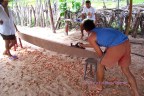
- The first piece
-
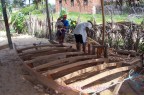
- The basic frame is constructed
-
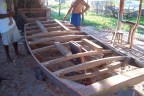
- The box for the removable keel is put in place
-
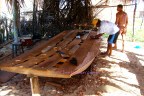
- The decking goes on
-
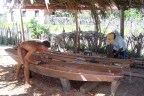
- The decking is planed
-
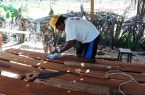
- Decking being nailed in place
-
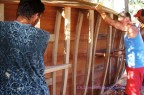
- The boat is turned over
-
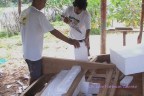
- The internal space is filled with polystyrene blocks cut to size
-
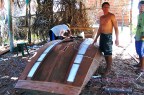
- The under planking is fitted
-
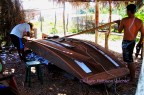
- Under planking goes on
-
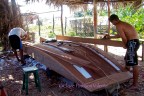
- Under planking goes on
-
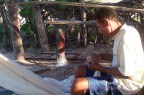
- Neu’s brother finishes the sails rigging
-
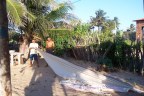
- Testing the sail against the mast for length
-
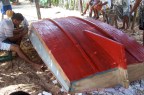
- The underside is painted
-
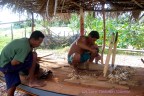
- The deck uprights for the mast housing are fitted
-
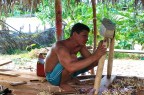
- The mast support
-
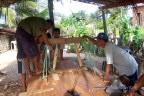
- The ropes for the mast support
-
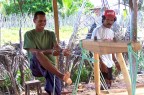
- Tightening the ropes
-
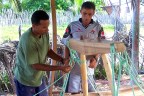
- More adjustments
-
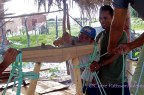
- Final measuring and adjustments of the mast housing
-
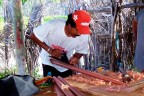
- Uprights for the back of the boat
-
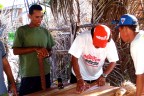
- Final piece of decking
-
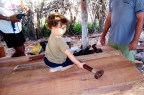
- Everyone lends a hand including our son.
-
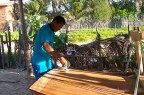
- Nail holes are filled
-

- The sail is tested against a spectacular sunset
-
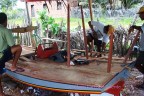
- Uprights go in place
-
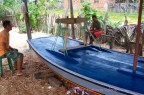
- Deck is painted
-
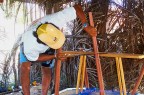
- Groove being cut for cross member
-
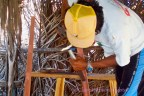
- Cutting the grooves
-

- Notice the use of safety equipment and safety clothing!
When I met him Neu had just made the final payment on his first jangada, a smaller boat at just over 3 meters, called Luar de Prata. That was a special boat which sadly is no more, being wooden they don’t last for ever. Neu had known the boat needed some substantial repairs but on closer inspection the main internal frame of the boat was rotten and so the boat was stripped down to salvage what they could of the wood, to be re used elsewhere. Neu now has bought half the wood needed to build a new jangada and hopes to recreate Luar de Prata in the future.
Winning with Valente .The story of how Neu, using Valente, won a local regatta despite being terribly ill with kidney failure.
 The English Woman's Blog
Good morning. I would like to purchase a small, but sea going Jangada sailing fishing boat. I’m thinking about 12 feet long. I live in Atlanta, GA. Do you know if that is even possible? Any idea of cost? and air to Atlanta? I can be reached at leonardmoody777@gmail.com Also, (770) 310-9915 Thanks
LikeLike
Good afternoon.
I guess anything is possible but it’s not something I can help you with, sorry.
My knowledge of boat building is limited to those my husband had built, a process that was often complicated enough, just from the way things are done here, I have no idea how you would do it from afar. You would need to speak good Portuguese or pay someone to manage the project for you I should think.
The exportation process would, I imagine, be very costly and probably very bureaucratic.
Good luck
LikeLike