Tags
Brazilan culture and traditions, Brazilian Indigenous tribes in Ceará, Events in Fortaleza, Herança Nativa, Nordeste, Povos do Mar, SESC
At the end of August I was lucky enough to go to the 8th annual gathering of Povos do Mar (Peoples of the Sea) organised and hosted by SESC Iparana at their Ecological Hotel in Caucaia, Fortaleza, Ceará.
SESC (Serviço Social do Comércio – Social Service of Commerce) was founded in 1947 with the purpose of promoting culture and, using it as a source of education, to transform and improve people’s lives. SESC operates in all the Brazilian states and is involved in a diverse range of the arts, as well as in recreation, health and education.

For Povos do Mar, SESC provided luxury coaches to bring groups of people to Fortaleza from communities all over the coastal region of Ceará, including our group of eight from Prainha. All these people were given accommodation in the top class hotel, with three meals a day included, free of charge. We really are incredibly lucky to be given this festival, which is open to the public, free to attend and set in the most beautiful grounds of the ecological hotel.
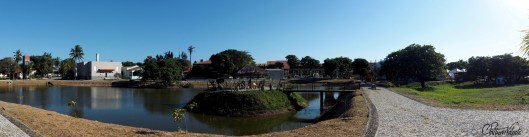
View from the far side of the lake


The event began on the Wednesday morning and went through five fully packed days to the Sunday. My only complaint was that there was so much going on, it was impossible to take part in everything and some hard choices had to be made between this workshop or that, one lecture or the other, seeing a dance group or learning a new skill. Events began at 7am and went on all day until late in the night and I would have loved for it to go on for longer.


On the Friday morning I went on a walk through the forest with the Pajé (medicine man) Luís Caboco from the Tremembé people. A man with so much knowledge of plants and their medicinal uses, listening to him was fascinating and inspiring.
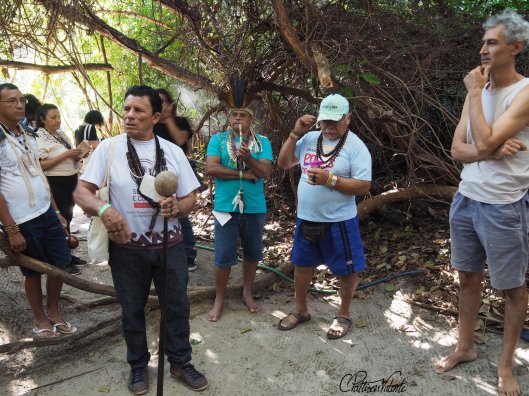
Pajé Luís Caboclo (on the left holding the staff)
In the afternoon I went for a healing ritual with Carlinhos Pitaguary of the Pitaguary people from Maracanaú. This was also held in the forest and I was one of about twenty people, of many different faiths. At the end of the ritual, Carlinhos led a prayer for Neu which was very powerful and deeply moving. Following on from which, Mãe Bia offered a blessing and advice on healing herbs for Neu and Mãe Katiane blessed me and gave me a necklace of silver beads with a little gold fish which symbolises Yamaya, Goddess of the sea. I felt truly blessed to have met them all.
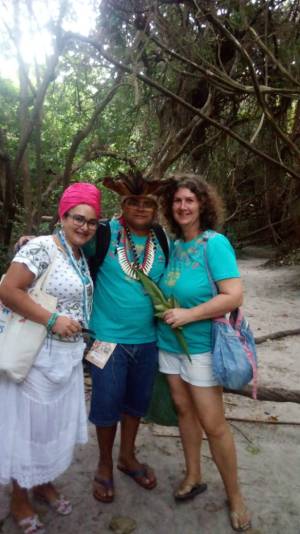
Mãe Katiane, Carlinhos Pitaguary and me
On Saturday morning I went to the Ecomuseu Natural do Mangue (The Natural Ecomuseum of the Mangrove). This is an environmental project run by Rusty and his wife Sineide, who decided to rescue and restore the mangrove on the river estuary in the area of Sabiaguaba, Fortaleza. They do fantastic work, educating visitors on the importance of the mangroves and encouraging people to clean out the rubbish which unfortunately accumulates there and, to plant more mangroves.


I thoroughly enjoyed myself at Povos do Mar. There is such a festive, friendly atmosphere and when on the Saturday night, one of the dance groups invited the audience to come onto the dance floor, I was more than willing to have a twirl. At the end of the dance I went to pick up my camera which I had, perhaps rather rashly, left with a woman who I didn’t know but was sitting next to me. Thankfully she was still there with my camera and, as I took my seat, her husband asked if I would be at the Herança Nativa (Native Heritage) event on the Monday. The man, whose name was Rogério, told me that he is one of the leaders of the Gypsies and said he thought I would enjoy the dancing they would be doing.
(This is the fourth year of Herança Nativa, it follows on immediately after Povos do Mar and brings in more of the Native Indigenous people, this time those from inland regions of Ceará come too. This event also includes Gypsies, known as Ciganos here, as well as people of Iberian descent.)
I told Rogério that I had relatively recently discovered that I have gypsy blood on my mothers side, it was something my grandmother was embarrassed by so I really know nothing about that ancestry. The man and his wife nodded at each other and she said, “Rogério knew you have the blood, he said so, he can always tell”. Rogério also said he meets very many people who, like me, have that heritage but know nothing about it. They were lovely people and it was a pleasure talking to them about their way of life. I would have loved the dancing and was now even more sorry that I would be going home on the Sunday.
Part of the reason I was at the event was to help with selling arts and crafts items made by people from the village, as well as my own things. After we had set up our stall I went to have a look at the other stalls and found Edimar Mendes from Paraipaba. Edimar burns images and designs onto wood, all beautifully done free-hand. One of his pieces really spoke to me but, as I had bought very little money with me, I decided I had better wait until the end of the event before buying anything.
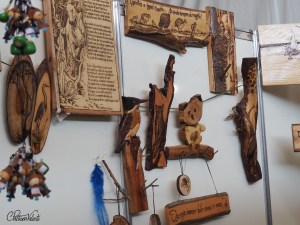
Pyrography by Edimar Mendes.
I was so happy that, on the last day, the piece that had so captivated me was still there. Edimar told me the wood was Ipé Roxa, which made the piece all the more meaningful to me, this is the tree that Neu focused on while he was in the intensive care unit, which helped him to hold on to life. Obviously the piece was meant for me and now sits over my desk.
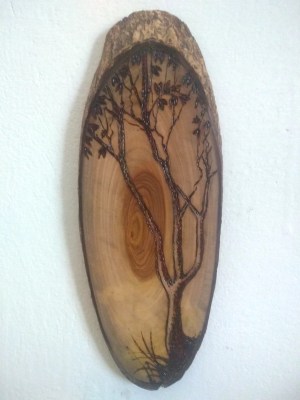
I missed the first part of the closing ceremony but the second part, run by the various indigenous tribes was fabulous, just a shame it was all over.


On the way home I read a little more about the events that would take place during Herança Nativa and found that on the Monday, as well as the gypsy dancing, there would be a workshop on making a bow and arrows and then another workshop on using them correctly. I decided to ask Neu and our son (who is always making his own bow and arrows with varying degrees of success) if they would like to come to the event, it was too good to miss.
On the Monday a friend drove us back to Fortaleza for Herança Nativa. Sadly I didn’t get to see the gypsy dancing, it was coming on late in the programme and we had to leave beforehand but our son did get to meet some people who happily shared their knowledge with him.
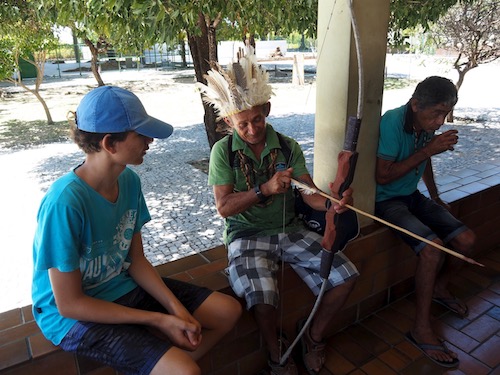
A little lesson in firing an arrow
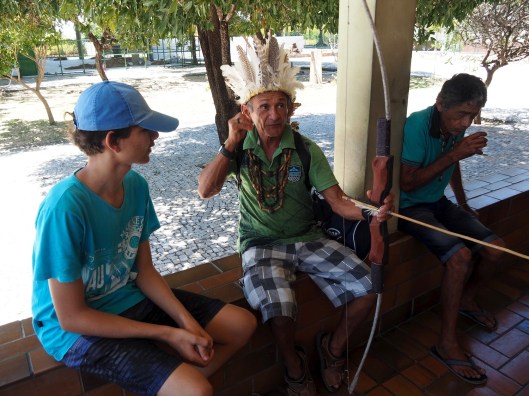
And then let it fly
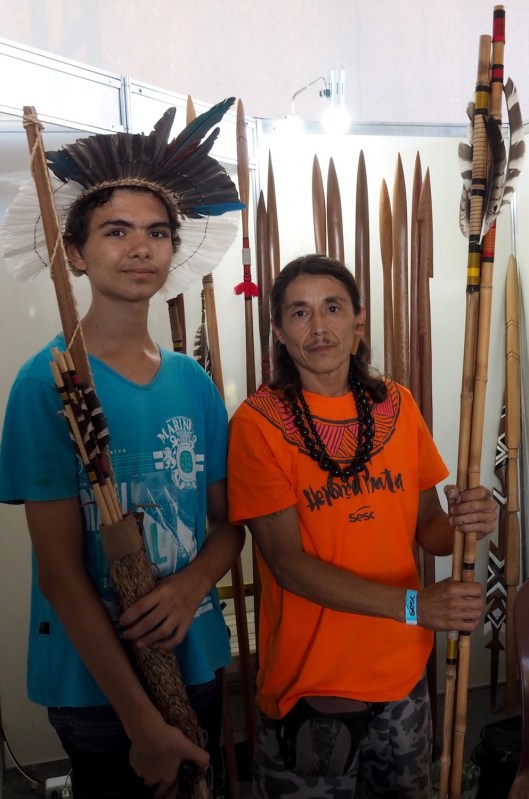
Our son, the proud owner of a new bow and arrow set, beautifully made by Dias Holanda.
One of those people was Dias Holanda from the Potiguara people of Crateús,* from whom we bought our son a beautiful bow and arrow set. I was more than happy to buy it because Dias obviously really knew his stuff and the price was incredibly low considering how much work had gone into it. In fact all of the items Dias’ had made and was selling that day were beautiful, all be it deadly. Money permitting I would have purchased more, he is a true craftsman and not only knows how to make the weapons but how to use them too. Dias later won Bronze and two Gold medals in the Indigenous Olympic Games in Canoeing, Battlefield skills and Archery, very well done to him.
I made a short compilation video, which really doesn’t do Povos do Mar justice but does give a flavour of what was on offer during the week. Enjoy
If you are interested in buying items from either of the craftsmen mentioned above (and can speak to them in Portuguese):
Edimar Mendes, Pirografia e Artesanato Rústico. Rod. Sol Poente, Sector D2- Paraipaba, WhatsApp 0055 85 996076714
Dias Holanda, Indigenous weapons – Tribo Potiguara, Aldeia Mandeira, Crateús WhatsApp 0055 88.998579495
Museu Natural do mangue, Rua Professor Valdivino, 48 – casa 1 – bairro: Sabiaguaba
Fortaleza, Brazil. Find them on Facebook here
If you are planning a visit to Fortaleza around August in the years to come, it would be well worth checking out when the event will be on. I can’t recommend it highly enough. http://www.sesc-ce.com.br/povos-do-mar-heranca-nativa/
 The English Woman's Blog
Pingback: Povos do Mar 2019 | The English Woman's Blog